

Sapien
Member
If you've spent time in crypto, you've probably come across USDC, USDT, DAI, USDe, PYUSD and FDUSD.
They're all designed to maintain a relatively stable value, usually around $1. But they don't all achieve that in the same way.
Some rely on traditional financial reserves. Others use cryptocurrency as collateral, automated supply mechanisms or strategies designed to generate yield.
And here's something worth knowing: a stablecoin can lose its peg even when it's supposed to be worth $1.
In this guide, we'll explore four categories of stablecoins, compare six popular examples, look at real depeg events, and explain how to check the information behind the coins you hold.
Let's get into it.
Fiat-backed stablecoins aim to maintain their value using reserves denominated in traditional currencies, usually the US dollar.
An issuer creates tokens and holds assets intended to support their value. These reserves may include cash, bank deposits and short-term US Treasury securities.
The idea behind this is simple: if one token represents one dollar, then the issuer should have sufficient eligible assets to support the tokens in circulation and meet its redemption obligations.
Four of our six stablecoins fit broadly into this category: USDC, USDT, PYUSD and FDUSD.
USDC is issued by Circle and is designed to maintain a 1:1 value with the US dollar.
Circle says its reserves consist of cash and cash-equivalent assets, with most of the reserve held in the Circle Reserve Fund, which invests in government money-market instruments.
USDC is widely used for trading, payments and DeFi. Circle also publishes reserve information and monthly independent attestation reports.
The risk to understand: in March 2023, USDC experienced a major depeg. Circle disclosed that $3.3 billion of USDC reserves were held at Silicon Valley Bank when the bank failed. USDC briefly fell to around $0.87 before recovering after authorities announced that depositors would be protected.
The incident showed that even a reserve-backed stablecoin can be affected by banking problems and uncertainty about access to its reserves.
Sources: Circle's USDC transparency page: https://www.circle.com/transparency. Federal Reserve analysis of the 2023 depeg: https://www.federalreserve.gov/econ...e-and-its-impact-on-stablecoins-20251217.html
USDT, commonly called Tether, is designed to stay close to $1 and is extensively used across crypto exchanges.
Tether reports reserves that include US Treasury securities, cash and cash equivalents, alongside other disclosed assets. Its reserve composition can change over time, so the latest report matters more than an old screenshot.
The risk to understand: USDT depends on Tether's reserve management, custody arrangements and ability to meet redemptions. Its widespread use does not remove issuer or counterparty risk.
Historically, Tether provided transparency into USDT's backing mainly through quarterly reserve attestations rather than a full independent audit of its financial statements. An attestation checks specified information about reported reserves at a particular date, while a full financial audit examines a company's financial statements more broadly.
In August 2026, Tether announced that KPMG had completed a full financial audit of Tether International, S.A. de C.V.'s 2025 financial statements. This is an important development, but it should not be confused with a full audit of every USDT reserve report. The scope of each report still matters.
Sources: Tether transparency: https://tether.to/transparency/. Tether's announcement of its 2025 financial audit https://tether.io/news/tether-completes-the-largest-inaugural-financial-audit-in-history/
PYUSD is branded by PayPal and issued by Paxos. It is a dollar-denominated stablecoin designed for payments and use across supported blockchain applications.
Paxos says PYUSD is backed by US dollar deposits, US Treasury securities and cash equivalents. It publishes monthly reserve reports and independent attestation reports.
The risk to understand: PYUSD depends on Paxos's reserve management and redemption arrangements. Its availability also varies across countries, platforms and networks, so it's best not to assume that every PayPal user can access every PYUSD feature.
Sources: Paxos PYUSD overview: https://www.paxos.com/pyusd. PYUSD transparency reports: https://www.paxos.com/pyusd-transparency.
FDUSD is a dollar-pegged stablecoin from the First Digital ecosystem. Its issuer says it is backed 1:1 by cash and cash-equivalent assets, including short-term US Treasury bills, and is designed to be redeemable for US dollars.
First Digital Labs publishes monthly reserve attestation reports to help users check whether the reported reserves cover the FDUSD tokens in circulation. The reserves are held separately through a custodian, First Digital Trust Limited, according to the issuer. FDUSD is also available across multiple blockchain networks, making it usable for crypto trading, transfers and payments. Source: First Digital Labs
The risk to understand: FDUSD experienced a sharp depeg in April 2025, briefly falling to around $0.87. The drop followed public allegations concerning First Digital Trust's ability to meet obligations in a separate dispute involving TrueUSD (TUSD). First Digital disputed the allegations and said FDUSD remained fully backed.
The episode is useful because it shows that market confidence can collapse even when the dispute concerns a related business rather than an established shortfall in the stablecoin's own reserves.
Sources: First Digital's transparency page: https://www.firstdigitallabs.com/transparency. The Block's April 2025 report: https://www.theblock.co/news/regula...vent-techteryx-tusd-first-digital-aria-349289

Crypto-backed stablecoins use cryptocurrency or other approved assets as collateral.
Instead of relying entirely on an issuer's traditional reserves, a protocol locks eligible collateral into smart contracts or related systems. The collateral supports the stablecoins created against it.
Because crypto prices can move quickly, these systems often require users to deposit more value than they borrow. This is called overcollateralisation.
DAI: A stablecoin built around collateral
DAI was developed by MakerDAO, whose ecosystem is now known as Sky Protocol.
Imagine you deposit $150 worth of eligible collateral to borrow 100 DAI. The extra $50 creates a buffer if the collateral loses value. These numbers are merely illustrative; actual collateral requirements depend on protocol rules and assets.
If collateral falls too far, the position may be liquidated to help cover the debt.
DAI's backing has evolved over time and includes a wider range of assets and arrangements, so it would be inaccurate to say that every DAI is backed only by ETH.
The risk to understand: DAI users face collateral crashes, liquidation, smart contract vulnerabilities and governance risks. Some backing arrangements can also introduce exposure to centralised financial institutions or real-world assets.
DAI is useful for understanding how decentralised finance can create dollar-linked assets through collateral and code.
Source: Sky Protocol's DAI documentation: https://developers.skyeco.com/protocol/tokens/dai/
Algorithmic stablecoins are stablecoins that attempt to maintain their peg using programmed rules, supply adjustments and market incentives. They may not have traditional reserves sufficient to redeem every token at $1.
Some designs use a second cryptocurrency to help absorb changes in demand. Others use different mechanisms to expand or contract supply.
The important point is that an algorithm is a mechanism, not a guarantee of stability.
TerraUSD, or UST, is the major warning story for this category.
Before its collapse in May 2022, UST was one of the largest algorithmic stablecoins. Its mechanism linked UST to a sister token called LUNA.
In simplified terms, users could exchange 1 UST for $1 worth of LUNA through the protocol, and vice versa. This arbitrage mechanism was intended to encourage the price to return to $1.
But the system depended heavily on market confidence and demand for LUNA.
When UST lost its peg, users tried to exit. The mechanism encouraged more LUNA to be created as UST was exchanged, adding selling pressure to LUNA's price. As confidence collapsed, the system entered a destructive feedback loop.
UST fell dramatically below $1, while LUNA's value collapsed. The episode wiped out enormous amounts of wealth and damaged confidence across the wider crypto market.
The lesson here is that a system can have smart contracts, an elegant mechanism and a clear explanation on paper, yet still fail when market incentives break down.
Sources: International Monetary Fund analysis of the Terra collapse: https://www.elibrary.imf.org/view/journals/063/2022/008/article-A001-en.xml). US Financial Stability Oversight Council report: https://home.treasury.gov/system/files/261/FSOC-Digital-Assets-Report-2022.pdf.
The risk to understand: Algorithmic designs can become unstable when confidence disappears, liquidity dries up or the mechanism supporting the peg stops working. Do not assume that automated supply controls are equivalent to redeemable dollar reserves.
UST is a historical example, not one of the six current comparison coins. None of USDC, USDT, DAI, USDe, PYUSD or FDUSD should simply be labelled an algorithmic stablecoin on the basis that it uses software.

Some stablecoins and stablecoin-related tokens are designed to provide yield in addition to dollar-linked exposure.
But yield-bearing does not automatically mean a new kind of backing. It describes how a token provides access to returns.
The source of that yield matters too.
Returns may come from lending interest, protocol fees, Treasury-related income, derivatives funding payments or other investment and trading strategies. Some products instead rely on token incentives, which may not be sustainable.
Let's look at two examples: USDe and sUSDe
Ethena's USDe is a synthetic dollar backed by assets and a derivatives hedging strategy. Its approach uses crypto assets alongside short positions intended to offset price exposure.
Ethena's staked token, sUSDe, provides access to the protocol's staking and reward mechanism. Returns depend on the strategy's results, including funding payments, staking income where applicable, and other protocol revenue or costs.
The extra risk: If funding rates turn negative, short positions may cost money to maintain rather than generate income. Derivatives venues, liquidity, custody and collateral problems can also affect the strategy. A high displayed yield is not a guaranteed return.
Official sources: Ethena documentation: https://docs.ethena.fi/. Ethena app and dashboard: https://app.ethena.fi/
DAI, sDAI, USDS and sUSDS
DAI and USDS are dollar-pegged stablecoins in the Sky ecosystem. sDAI and sUSDS are savings or yield-bearing tokens associated with their respective savings mechanisms.
In simple terms, users deposit DAI or USDS into a savings system and receive a token representing their position. Depending on the token mechanics, the value redeemable for the underlying stablecoin can increase as savings yield accrues.
For sUSDS, the Sky Savings Rate is variable and funded from aggregate Sky Protocol surplus. That surplus can come from several protocol activities, including lending and other revenue-generating arrangements. Governance can change the rate too.
The extra risk: Yield depends on protocol revenue, governance decisions and smart contract operation. The rate can fall, and the system can face risks from its collateral, counterparties and financial activities. Yield should never be treated as guaranteed simply because it is displayed in an app.
Sources: Sky's explanation of sUSDS yield: https://sky.money/blog/where-does-susds-yield-come-from. Sky's sUSDS page: https://sky.money/susds
One more distinction: holding a dollar-pegged token is not the same as holding a yield-bearing version. Always check the exact token ticker and how its returns are generated.

This distinction matters when comparing stablecoins.
An attestation is an independent accountant's examination of specific information or management claims, such as whether reserve assets meet or exceed tokens in circulation on a particular date.
On the other hand, an audit is a broader examination of financial statements under applicable auditing standards. It considers whether those statements are fairly presented in all material respects and involves work on financial reporting and relevant controls.
Neither term should be treated as a magic stamp guaranteeing that a stablecoin can never fail.
A reserve attestation is useful, but it is not necessarily a full audit of the issuer's entire business, its internal controls or every risk affecting redemption.
Here is the current distinction to keep in mind:
Sources: Circle transparency: https://www.circle.com/transparency. Tether transparency: https://tether.to/transparency/. Paxos PYUSD attestations: https://www.paxos.com/pyusd-transparency. First Digital Labs transparency: https://www.firstdigitallabs.com/transparency.
A depeg happens when a stablecoin moves meaningfully away from its intended reference value.
Three cases show why this matters:
These events had different causes. USDC's episode involved banking exposure and temporary uncertainty over reserves. UST suffered a fundamental failure in its stabilisation mechanism. FDUSD's drop followed a confidence shock and dispute involving a related financial business. The USDT fall triggered heavy redemptions and concerns about Tether's reserves, but USDT later recovered its dollar peg.
That is why checking only whether a stablecoin claims to be backed 1:1 is not enough. You also need to understand its redemption process, financial dependencies and market liquidity.
For live prices and deviations, use DefiLlama's stablecoin dashboard: https://defillama.com/stablecoins.
Historical market data and reporting can help you investigate past events, but no dashboard predicts the next depeg.
Before trusting a stablecoin, it's best to look beyond its marketing page.
Here are useful starting points:
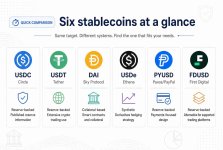
Below is a quick comparison of the six tokens.
These labels describe their main mechanisms, not a ranking of safety. Yield-bearing tokens are a separate feature that can overlap with other categories.
Stablecoins are useful tools, but their risks depend on what backs them, how their mechanisms work and whether users can access their funds when they need them.
Fiat-backed coins rely on reserves and redemption arrangements. Crypto-backed coins depend on collateral and protocol rules. Algorithmic designs can fail when their stabilisation mechanisms break down. Yield-bearing tokens add another question: where does the return come from, and what could make it disappear?
Before choosing a stablecoin, check its official disclosures, understand its history and compare its live market data.
Because in crypto, seeing "$1" beside a token is only the beginning of the story.
Disclaimer: This article is for educational purposes only and is not financial advice. Stablecoins can lose their peg, and yield-bearing products can lose value. Reserve disclosures and dashboards have limits and do not guarantee future stability or returns. Always do your own research.
They're all designed to maintain a relatively stable value, usually around $1. But they don't all achieve that in the same way.
Some rely on traditional financial reserves. Others use cryptocurrency as collateral, automated supply mechanisms or strategies designed to generate yield.
And here's something worth knowing: a stablecoin can lose its peg even when it's supposed to be worth $1.
In this guide, we'll explore four categories of stablecoins, compare six popular examples, look at real depeg events, and explain how to check the information behind the coins you hold.
Let's get into it.
Fiat-backed stablecoins: Digital dollars backed by traditional assets
Fiat-backed stablecoins aim to maintain their value using reserves denominated in traditional currencies, usually the US dollar.
An issuer creates tokens and holds assets intended to support their value. These reserves may include cash, bank deposits and short-term US Treasury securities.
The idea behind this is simple: if one token represents one dollar, then the issuer should have sufficient eligible assets to support the tokens in circulation and meet its redemption obligations.
Four of our six stablecoins fit broadly into this category: USDC, USDT, PYUSD and FDUSD.
USDC: Circle's digital dollar
USDC is issued by Circle and is designed to maintain a 1:1 value with the US dollar.
Circle says its reserves consist of cash and cash-equivalent assets, with most of the reserve held in the Circle Reserve Fund, which invests in government money-market instruments.
USDC is widely used for trading, payments and DeFi. Circle also publishes reserve information and monthly independent attestation reports.
The risk to understand: in March 2023, USDC experienced a major depeg. Circle disclosed that $3.3 billion of USDC reserves were held at Silicon Valley Bank when the bank failed. USDC briefly fell to around $0.87 before recovering after authorities announced that depositors would be protected.
The incident showed that even a reserve-backed stablecoin can be affected by banking problems and uncertainty about access to its reserves.
Sources: Circle's USDC transparency page: https://www.circle.com/transparency. Federal Reserve analysis of the 2023 depeg: https://www.federalreserve.gov/econ...e-and-its-impact-on-stablecoins-20251217.html
USDT: Tether's widely used stablecoin
USDT, commonly called Tether, is designed to stay close to $1 and is extensively used across crypto exchanges.
Tether reports reserves that include US Treasury securities, cash and cash equivalents, alongside other disclosed assets. Its reserve composition can change over time, so the latest report matters more than an old screenshot.
The risk to understand: USDT depends on Tether's reserve management, custody arrangements and ability to meet redemptions. Its widespread use does not remove issuer or counterparty risk.
Historically, Tether provided transparency into USDT's backing mainly through quarterly reserve attestations rather than a full independent audit of its financial statements. An attestation checks specified information about reported reserves at a particular date, while a full financial audit examines a company's financial statements more broadly.
In August 2026, Tether announced that KPMG had completed a full financial audit of Tether International, S.A. de C.V.'s 2025 financial statements. This is an important development, but it should not be confused with a full audit of every USDT reserve report. The scope of each report still matters.
Sources: Tether transparency: https://tether.to/transparency/. Tether's announcement of its 2025 financial audit https://tether.io/news/tether-completes-the-largest-inaugural-financial-audit-in-history/
PYUSD: PayPal USD
PYUSD is branded by PayPal and issued by Paxos. It is a dollar-denominated stablecoin designed for payments and use across supported blockchain applications.
Paxos says PYUSD is backed by US dollar deposits, US Treasury securities and cash equivalents. It publishes monthly reserve reports and independent attestation reports.
The risk to understand: PYUSD depends on Paxos's reserve management and redemption arrangements. Its availability also varies across countries, platforms and networks, so it's best not to assume that every PayPal user can access every PYUSD feature.
Sources: Paxos PYUSD overview: https://www.paxos.com/pyusd. PYUSD transparency reports: https://www.paxos.com/pyusd-transparency.
FDUSD: First Digital USD
FDUSD is a dollar-pegged stablecoin from the First Digital ecosystem. Its issuer says it is backed 1:1 by cash and cash-equivalent assets, including short-term US Treasury bills, and is designed to be redeemable for US dollars.
First Digital Labs publishes monthly reserve attestation reports to help users check whether the reported reserves cover the FDUSD tokens in circulation. The reserves are held separately through a custodian, First Digital Trust Limited, according to the issuer. FDUSD is also available across multiple blockchain networks, making it usable for crypto trading, transfers and payments. Source: First Digital Labs
The risk to understand: FDUSD experienced a sharp depeg in April 2025, briefly falling to around $0.87. The drop followed public allegations concerning First Digital Trust's ability to meet obligations in a separate dispute involving TrueUSD (TUSD). First Digital disputed the allegations and said FDUSD remained fully backed.
The episode is useful because it shows that market confidence can collapse even when the dispute concerns a related business rather than an established shortfall in the stablecoin's own reserves.
Sources: First Digital's transparency page: https://www.firstdigitallabs.com/transparency. The Block's April 2025 report: https://www.theblock.co/news/regula...vent-techteryx-tusd-first-digital-aria-349289
Crypto-backed stablecoins: Cryptocurrency supporting a digital dollar
Crypto-backed stablecoins use cryptocurrency or other approved assets as collateral.
Instead of relying entirely on an issuer's traditional reserves, a protocol locks eligible collateral into smart contracts or related systems. The collateral supports the stablecoins created against it.
Because crypto prices can move quickly, these systems often require users to deposit more value than they borrow. This is called overcollateralisation.
DAI: A stablecoin built around collateral
DAI was developed by MakerDAO, whose ecosystem is now known as Sky Protocol.
Imagine you deposit $150 worth of eligible collateral to borrow 100 DAI. The extra $50 creates a buffer if the collateral loses value. These numbers are merely illustrative; actual collateral requirements depend on protocol rules and assets.
If collateral falls too far, the position may be liquidated to help cover the debt.
DAI's backing has evolved over time and includes a wider range of assets and arrangements, so it would be inaccurate to say that every DAI is backed only by ETH.
The risk to understand: DAI users face collateral crashes, liquidation, smart contract vulnerabilities and governance risks. Some backing arrangements can also introduce exposure to centralised financial institutions or real-world assets.
DAI is useful for understanding how decentralised finance can create dollar-linked assets through collateral and code.
Source: Sky Protocol's DAI documentation: https://developers.skyeco.com/protocol/tokens/dai/
Algorithmic stablecoins: When the mechanism fails
Algorithmic stablecoins are stablecoins that attempt to maintain their peg using programmed rules, supply adjustments and market incentives. They may not have traditional reserves sufficient to redeem every token at $1.
Some designs use a second cryptocurrency to help absorb changes in demand. Others use different mechanisms to expand or contract supply.
The important point is that an algorithm is a mechanism, not a guarantee of stability.
The TerraUSD (UST) collapse
TerraUSD, or UST, is the major warning story for this category.
Before its collapse in May 2022, UST was one of the largest algorithmic stablecoins. Its mechanism linked UST to a sister token called LUNA.
In simplified terms, users could exchange 1 UST for $1 worth of LUNA through the protocol, and vice versa. This arbitrage mechanism was intended to encourage the price to return to $1.
But the system depended heavily on market confidence and demand for LUNA.
When UST lost its peg, users tried to exit. The mechanism encouraged more LUNA to be created as UST was exchanged, adding selling pressure to LUNA's price. As confidence collapsed, the system entered a destructive feedback loop.
UST fell dramatically below $1, while LUNA's value collapsed. The episode wiped out enormous amounts of wealth and damaged confidence across the wider crypto market.
The lesson here is that a system can have smart contracts, an elegant mechanism and a clear explanation on paper, yet still fail when market incentives break down.
Sources: International Monetary Fund analysis of the Terra collapse: https://www.elibrary.imf.org/view/journals/063/2022/008/article-A001-en.xml). US Financial Stability Oversight Council report: https://home.treasury.gov/system/files/261/FSOC-Digital-Assets-Report-2022.pdf.
The risk to understand: Algorithmic designs can become unstable when confidence disappears, liquidity dries up or the mechanism supporting the peg stops working. Do not assume that automated supply controls are equivalent to redeemable dollar reserves.
UST is a historical example, not one of the six current comparison coins. None of USDC, USDT, DAI, USDe, PYUSD or FDUSD should simply be labelled an algorithmic stablecoin on the basis that it uses software.
Yield-bearing stablecoins: A dollar-linked asset that can earn a return
Some stablecoins and stablecoin-related tokens are designed to provide yield in addition to dollar-linked exposure.
But yield-bearing does not automatically mean a new kind of backing. It describes how a token provides access to returns.
The source of that yield matters too.
Returns may come from lending interest, protocol fees, Treasury-related income, derivatives funding payments or other investment and trading strategies. Some products instead rely on token incentives, which may not be sustainable.
Let's look at two examples: USDe and sUSDe
Ethena's USDe is a synthetic dollar backed by assets and a derivatives hedging strategy. Its approach uses crypto assets alongside short positions intended to offset price exposure.
Ethena's staked token, sUSDe, provides access to the protocol's staking and reward mechanism. Returns depend on the strategy's results, including funding payments, staking income where applicable, and other protocol revenue or costs.
The extra risk: If funding rates turn negative, short positions may cost money to maintain rather than generate income. Derivatives venues, liquidity, custody and collateral problems can also affect the strategy. A high displayed yield is not a guaranteed return.
Official sources: Ethena documentation: https://docs.ethena.fi/. Ethena app and dashboard: https://app.ethena.fi/
DAI, sDAI, USDS and sUSDS
DAI and USDS are dollar-pegged stablecoins in the Sky ecosystem. sDAI and sUSDS are savings or yield-bearing tokens associated with their respective savings mechanisms.
In simple terms, users deposit DAI or USDS into a savings system and receive a token representing their position. Depending on the token mechanics, the value redeemable for the underlying stablecoin can increase as savings yield accrues.
For sUSDS, the Sky Savings Rate is variable and funded from aggregate Sky Protocol surplus. That surplus can come from several protocol activities, including lending and other revenue-generating arrangements. Governance can change the rate too.
The extra risk: Yield depends on protocol revenue, governance decisions and smart contract operation. The rate can fall, and the system can face risks from its collateral, counterparties and financial activities. Yield should never be treated as guaranteed simply because it is displayed in an app.
Sources: Sky's explanation of sUSDS yield: https://sky.money/blog/where-does-susds-yield-come-from. Sky's sUSDS page: https://sky.money/susds
One more distinction: holding a dollar-pegged token is not the same as holding a yield-bearing version. Always check the exact token ticker and how its returns are generated.
Attestations vs audits: What do the reports actually prove?
This distinction matters when comparing stablecoins.
An attestation is an independent accountant's examination of specific information or management claims, such as whether reserve assets meet or exceed tokens in circulation on a particular date.
On the other hand, an audit is a broader examination of financial statements under applicable auditing standards. It considers whether those statements are fairly presented in all material respects and involves work on financial reporting and relevant controls.
Neither term should be treated as a magic stamp guaranteeing that a stablecoin can never fail.
A reserve attestation is useful, but it is not necessarily a full audit of the issuer's entire business, its internal controls or every risk affecting redemption.
Here is the current distinction to keep in mind:
- USDC: Circle publishes monthly independent reserve attestations. Circle's corporate financial statements have also been audited by Deloitte, but that is distinct from the monthly USDC reserve examination.
- USDT: Tether has historically published quarterly reserve attestations, including reports by BDO. In August 2026, it announced a full audit of Tether International's 2025 financial statements by KPMG. Read the scope carefully though: a company financial audit and a token reserve report answer different questions.
- PYUSD: Paxos publishes monthly reserve reports and independent attestations. Its reports from February 28, 2025 onward are issued by KPMG.
- FDUSD: First Digital Labs publishes monthly reserve attestations. Check the specific report for its date, scope and independent examiner.
- DAI and USDe: These require a different research approach. Review protocol documentation, collateral data, smart contract information and relevant risk dashboards. A public blockchain does not replace an independent financial audit.
Sources: Circle transparency: https://www.circle.com/transparency. Tether transparency: https://tether.to/transparency/. Paxos PYUSD attestations: https://www.paxos.com/pyusd-transparency. First Digital Labs transparency: https://www.firstdigitallabs.com/transparency.
Depeg history: When $1 stops being $1
A depeg happens when a stablecoin moves meaningfully away from its intended reference value.
Three cases show why this matters:
| Stablecoin | Event | What happened |
| USDC | March 2023 | Fell to roughly $0.87 amid concern about reserves held at Silicon Valley Bank; recovered after the banking response |
| UST | May 2022 | Its algorithmic mechanism failed, leading to a collapse alongside LUNA |
| FDUSD | April 2025 | Fell to roughly $0.87 amid public allegations concerning First Digital Trust; the issuer disputed the allegations |
| USDT | May 2022 | Fell to around $0.95 on some exchanges amid market panic following the UST collapse. It also traded as low as roughly $0.85 on some exchanges in October 2018. |
These events had different causes. USDC's episode involved banking exposure and temporary uncertainty over reserves. UST suffered a fundamental failure in its stabilisation mechanism. FDUSD's drop followed a confidence shock and dispute involving a related financial business. The USDT fall triggered heavy redemptions and concerns about Tether's reserves, but USDT later recovered its dollar peg.
That is why checking only whether a stablecoin claims to be backed 1:1 is not enough. You also need to understand its redemption process, financial dependencies and market liquidity.
For live prices and deviations, use DefiLlama's stablecoin dashboard: https://defillama.com/stablecoins.
Historical market data and reporting can help you investigate past events, but no dashboard predicts the next depeg.
Transparency dashboards: Where to check your stablecoin
Before trusting a stablecoin, it's best to look beyond its marketing page.
Here are useful starting points:
- DefiLlama Stablecoins: https://defillama.com/stablecoins - Compare market capitalisation, supply, price and peg deviations across stablecoins.
- Circle transparency: https://www.circle.com/transparency - Review USDC reserves and monthly reports.
- Tether transparency: https://tether.to/transparency/ - Review USDT reserve reporting and related disclosures.
- Paxos PYUSD transparency: https://www.paxos.com/pyusd-transparency - Access PYUSD reserve reports and attestations.
- First Digital Labs transparency - https://www.firstdigitallabs.com/transparency - Review FDUSD reserve information and reports.
- Ethena app: https://app.ethena.fi/ - Explore USDe-related information and available protocol metrics.
- Sky financial dashboard: https://info.skyeco.com/ - Explore Sky Protocol's financial information and relevant system data.
USDC vs USDT vs DAI vs USDe vs PYUSD vs FDUSD
Below is a quick comparison of the six tokens.
| Token | Main category | Main thing to understand |
| USDC | Fiat-backed | Circle's reserves and banking exposure |
| USDT | Fiat-backed | Tether's reserves, reporting and redemption |
| DAI | Crypto-backed | collateral-based| Collateral, liquidation and protocol governance |
| USDe | Synthetic, with yield-bearing sUSDe | Derivatives hedging and funding rates |
| PYUSD | Fiat-backed | Paxos reserves and payment availability |
| FDUSD | Fiat-backed | Reserve disclosures and confidence in the issuer's arrangements |
These labels describe their main mechanisms, not a ranking of safety. Yield-bearing tokens are a separate feature that can overlap with other categories.
Conclusion: Don't just trust the ticker
Stablecoins are useful tools, but their risks depend on what backs them, how their mechanisms work and whether users can access their funds when they need them.
Fiat-backed coins rely on reserves and redemption arrangements. Crypto-backed coins depend on collateral and protocol rules. Algorithmic designs can fail when their stabilisation mechanisms break down. Yield-bearing tokens add another question: where does the return come from, and what could make it disappear?
Before choosing a stablecoin, check its official disclosures, understand its history and compare its live market data.
Because in crypto, seeing "$1" beside a token is only the beginning of the story.
Disclaimer: This article is for educational purposes only and is not financial advice. Stablecoins can lose their peg, and yield-bearing products can lose value. Reserve disclosures and dashboards have limits and do not guarantee future stability or returns. Always do your own research.
Attachments



Last edited: